The Hunger Games Economy

I went to the grocery store yesterday and when I checked out I thought I bought a gold bar by accident...
Both CPI and PPI came in much hotter than expected this week, but nevertheless government inflation statistics are systematically understating how much costs are rising for the average family. Why? Because CPI doesn't take into account which costs are discretionary and which ones are essential goods. Food and energy are the fastest rising components of CPI and they are stripped out of core CPI. Meanwhile, low cost imported goods such as clothing and electronics are discretionary which means that they inaccurately pull the CPI DOWN. Discretionary items are deflationary and essential goods are inflationary, the net effect is that households are force imploding.
Economists call this type of economy a "K shaped" economy, but unfortunately there is no such thing. The term was only recently invented. What it implies is that for the wealthy their standard of living is rising due to Asset Inflation (AI), but for the overwhelming majority their standard of living is falling due to rising prices and falling wages and decreasing job prospects.
It's clear now that the AI investment bubble is hiding an incipient recession in the United States. GDP shows consumer spending is increasing, but that's only because prices are going up. Spending $80 on a tank of gas versus $40 does not imply that consumers are doing well, and yet that's how economists are misreading it. The $750 billion exogenous investment bubble is hiding the economic pain being felt by households. The AI bubble is inflating U.S. GDP by 2% and GDP growth is only 2%. Which means there is no growth outside of AI. Factor in a 6% deficit and had this amount of exogenous stimulus been applied every year since WWII the U.S. would have had ZERO official recessions, but the country would have been bankrupt a long time ago.
This is the height of idiocy right now.

What's happening in financial markets mirrors what is happening in the economy - there is now a bifurcated market, with very few winners and an increasing number of losers. The winners are all of the beneficiaries from the AI investment boom - semiconductors, fiber optics, construction equipment, raw materials, power generation etc. The lagging sectors are all the ones facing the imploding consumer. Retail and restaurant stocks in particular are getting hit hard along with financial stocks. Spirit Airlines just imploded.
The stock market is now a zero sum game between the soaring AI economy and the collapsing human economy.

"On the same day the S&P 500 set a record [high], 5.6% of its components hit new 52-week lows, a rare signal observed only in July 1929, January 1973, and December 1999. Each of those instances preceded severe bear markets, from the Great Depression to the dot-com collapse"
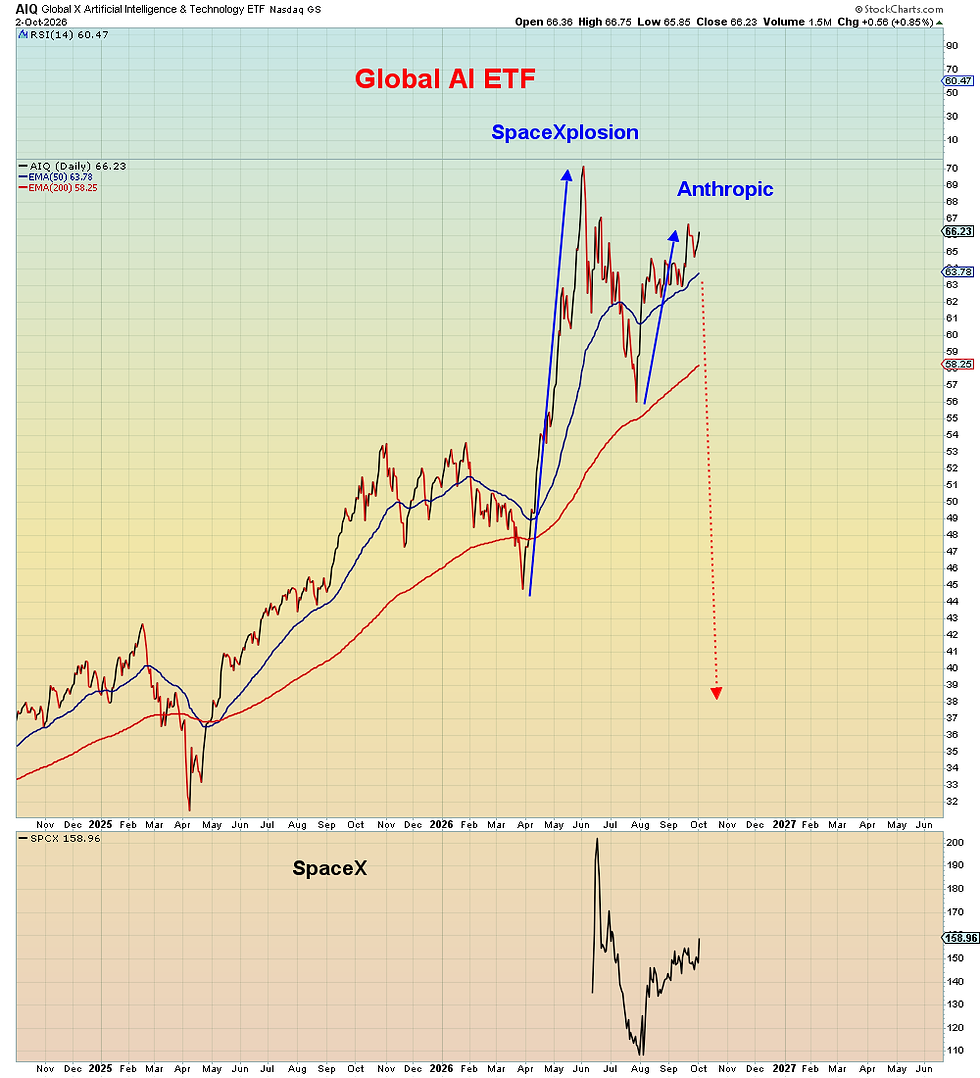
From an investment allocation perspective, the consumer recession is pushing ALL investors globally into the same handful of overvalued stocks and Wall Street is ignoring the extreme over-valuation. In other words, recession is now fueling the AI stock bubble.
For the time being, AI investment is hiding a recession, but what economists are ignoring is that this level of investment is not sustainable long-term and it will ultimately reduce consumption due to mass layoffs. So the net long-term impact will be reduced investment AND reduced consumption when the bubble implodes.
In addition, global central banks are now on a tightening path due to the war:
Now imagine Fed rate hikes on top of inflation. The consumer will be Dead On Arrival.

In summary, oligarchs are making an existential bet on AI displacing U.S. workers with AI bots. In the process they are imploding the U.S. consumer, but the oligarchs are totally oblivious to the economic pain.
Trump himself is an oligarch, therefore he himself is totally oblivious to the economic pain.
If you don't believe me, this is what he said this week:

So the pain is going up, but the people causing the pain are watching their wealth increase DAILY.
Until that changes, the policies causing pain will remain the same. Which means that the AI bubble must implode before there is a sense of "shared" pain.
Now if you look at this chart below, you will see the difference between now and Y2K.
As a relative size of the overall market, Tech is larger now than in 2000 which means there is now greater risk to the forward returns of the S&P 500 when Tech implodes.
But we also see in the lower pane that consumer sentiment was at a fifty year high in Y2K and now it's at an all time low.
Why is that? It's because the internet WAS not a zero sum game technology.
Whereas the goal of AI is to reduce labor costs.
And we can see that it's working exactly as designed.