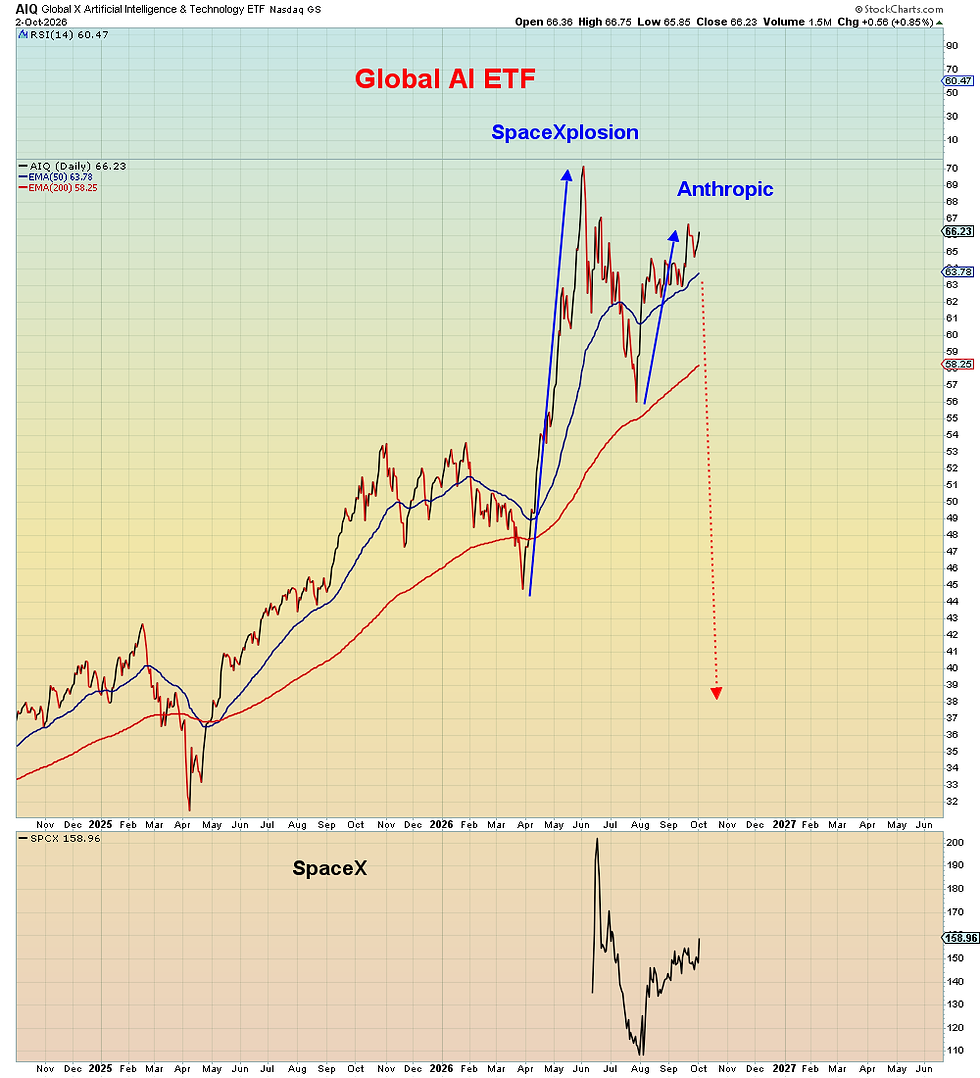
The AI Moron Bubble Is Over

Many bull pundits are now pointing to the Dow as confirmation that the Moron Bubble is NOT over. However, I suggest that it will not pay to wait for consensus confirmation for when this bubble ends. In an Idiocracy there is no strength in numbers.
Bubbles burst when investors allocate capital to unprofitable sectors based upon pure speculation and non-financial growth metrics such as "daily user count". In Y2K the well known unprofitable stocks were the Dotcom internet companies that imploded first, at which point investors rotated to the perceived safety of the larger and more profitable stocks such as Microsoft, Cisco, Intel, and Oracle. But then those stocks imploded as well. Why? Because their biggest customers were the unprofitable DotCom stocks.
Deja vu of that disaster, here is the "existential" headline I vowed we would get and we (finally) got last week after Amazon earnings:

"The market has spoken: It doesn't like the massive AI spending spree of the 'Big Four' hyperscalers. But the companies are barreling ahead anyway."
To continue funding the buildout, hyperscalers "are going from huge cash-flow generators to huge debt issuers"
Nobody really knows how and when these massive investments will pay off - not even the leaders of the companies doing the spending. But the fear of missing out on AI is continuing to propel capex levels higher."
It's a capex death spiral that is imploding the largest Tech companies in the market in order to chase a mythological AI finish line that does not exist. Nothing could be worse for the stock market.
The various sector crashes we have seen so far in 2026 are indications that the market is disintegrating. So far, the damage has been limited to metals/miners. Cryptos. Software/cloud stocks, and of course now hyperscalers. However this latest stage rotation to Dow cyclicals and out of Tech is deja vu of Y2K. The same thing happened back then but it was a disaster for the overall market. Why? Because the Dow is a price weighted index therefore stocks having a high price but low market cap are the ones that move it higher. This past weekend Barron's informed us that a mere four stocks were primarily responsible for the Dow hitting 50,000: Caterpillar, Goldman Sachs, Amgen, Sherwin Williams. Those four stocks have a combined market cap of a mere ~$1trillion. Contrary to popular belief, we can't replace Microsoft with a paint company:

"Those four stocks all have high share prices, which means they have a bigger impact on the price-weighted Dow than they would if the index was weighted according to market value"
While the price weighted Dow was hitting new highs, the largest Tech stocks by market cap imploded below the 200 day moving average last week and then staged a dead cat bounce. These 10 FANG+ Tech stocks which include all of the MAG7 (MSFT, AAPL, NVDA, META, AMZN, GOOGL, TSLA) + Netflix, Broadcom and Snowflake have a combined market cap of ~$22 trillion. In other words those stocks dropped 5% on the week and lost as much market cap as equals the entire market cap of the four stocks driving the Dow higher.

Looking back to Y2K on a long-term view, we see that the Dow was not spared the bear market. It just went down less in percent terms. However it doesn't matter, because most investors don't own the Dow, they are in the S&P 500 which is much more heavily weighted towards Tech stocks than the Dow:

What happened to S&P 500 index fund jockeys in Y2K is repeating now: i.e. Tech overweight imploded the index:

"When a few megacap stocks do all the heavy lifting, index funds lose their value as a diversified cushion, instead rising and falling based on Big Tech’s fortunes"
"Already some of the world’s biggest investment management companies, including Vanguard and Fidelity, have made changes to their disclosures to warn investors of “non-diversification” risk.
In this long-term chart we see that after the Y2K Tech bubble collapsed, the S&P 500 took almost 15 years to make a new high post-Y2K. And, we also see (lower pane) that U.S. household allocation to stocks as a percentage is higher now than it was back then. In other words households are MORE allocated to Tech than they were in Y2K.
It's a disaster.

In summary, bulls are now clinging to the price-weighted Dow as indication that the AI Moron Bubble is NOT over. However I suggest that fact alone is indication that it IS over.
And it's imploding in broad daylight.
My advice, don't wait for consensus confirmation.