Party Like It's 1929

This coming week (August 1st), Trump will raise tariffs to the highest level since 1934, but markets are partying like it's 1929. Therefore it falls on us to ask "What could go wrong?". Because who else would question mass insanity?
In this chart I use the Aussie Dollar which is a commonly used proxy for global macro. What we see is a chasmic gap between risk assets (Global Dow) and global macro - which has been caused by pre-emptive global monetary easing (ex-U.S.) in response to Trump's trade war. Stocks are no longer following the global economy, they are following central bank liquidity.

Last week, BofA issued a proprietary market "sell" signal based upon the collapse in fund manager cash levels:
"The last three months witnessed the biggest spike on record for risk appetite, according to Bank of America’s global fund manager survey for July"
When you look at the BofA chart of proprietary sell signals, the last one occurred in January 2021 which was the apex of the pandemic speculative mania. And of course this week there were many headlines regarding the froth in meme stocks. Which follows recent froth in IPOs, froth in Ark ETFs, froth in Chinese internet stocks, and froth in Cryptos. All of which is deja vu of January 2021. When it all collapsed back in early February 2021, led by Gamestop explosion, at the time it was the highest Nasdaq down volume in history. Higher than the pandemic. But the volume we just saw in April was even much higher. So I predict this impending volume will make those spikes look minor by comparison.

This week the low volume, low volatility melt-up continued, so BofA just renewed their warning about bubble risk, highlighting what I said above about monetary policy easing fueling an asset bubble:

"The team led by Michael Hartnett said the world policy rate has fallen to 4.4% from 4.8% in the past year as central banks in the US, UK, Europe and China slashed borrowing costs. The rate is forecast to drop further to 3.9% in the coming 12 months, he said."
The net effect of the trade war has been to lower global (ex-U.S.) borrowing costs while keeping U.S. borrowing costs at cycle highs where they have imploded the housing market.
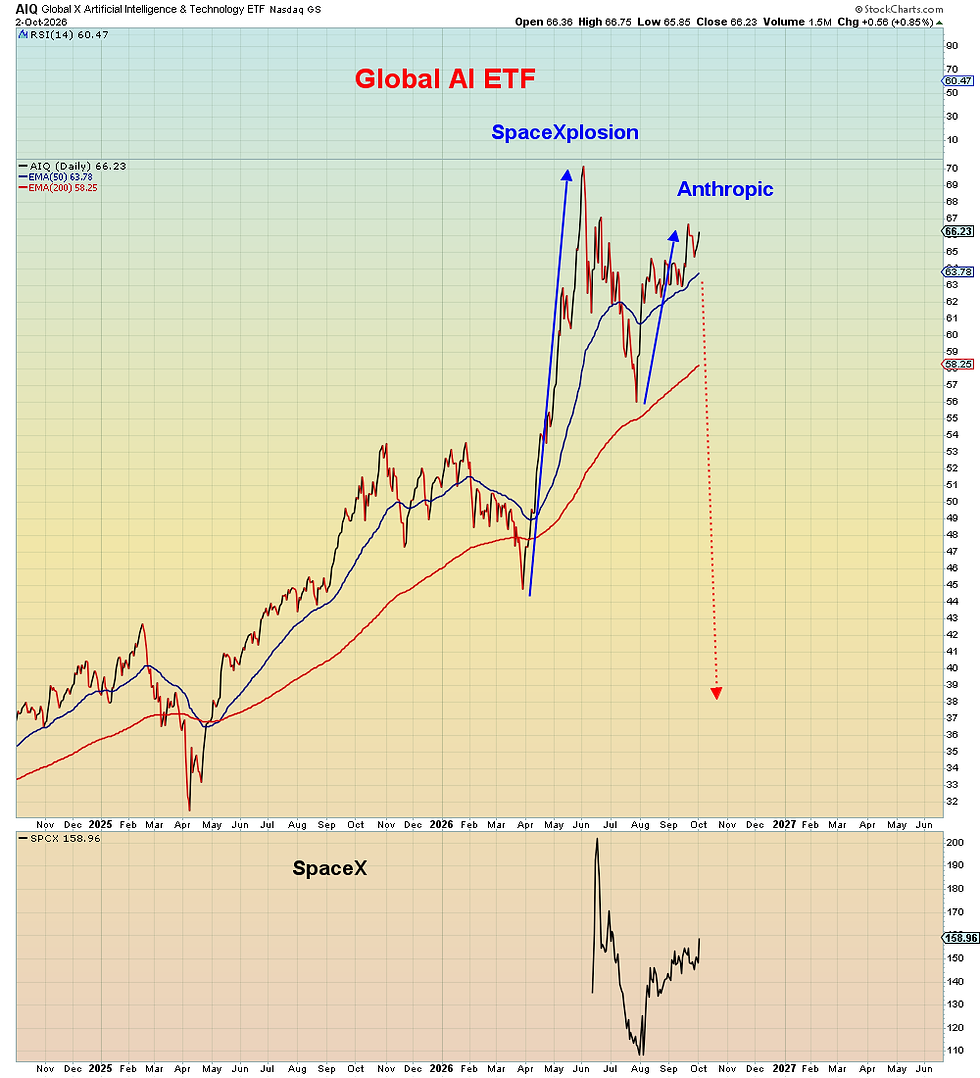
What's worse is that record AI investment is hiding a fall in investment in the remainder of the economy. One must ask for example why did semiconductor companies Texas Instruments and Intel both crash this week and it's because they both have greater exposure to mainline computing than they have to AI.
What it all points to is a massively crowded AI trade that is giving the illusion of a strong economy and a strong stock market. The very technology that will make the recession far worse, is preventing people from seeing recession in the first place. All due to RECORD misallocation of capital which will be destroyed post haste in the bear market.
In this chart we see that the number of stocks making new highs this week (lower pane) is the same number of stocks that attended the Nasdaq 100 LOWER high back in 2022.
Only 7% of stocks are driving this market higher now.

The Nasdaq 100 shown above consists mainly of large cap stocks. However, the divergence in the broader market is far worse. Below we see the small cap index has in no way confirmed this latest S&P high (S&P is shown in background).
New highs are even worse than in 2022. And what this wave count shows is that the broader market is about to go into Wave '3' down which is the WORST part of the crash. And when that happens, then those few mega caps holding this illusion up at all time highs on non-existent volume, will collapse like a cheap tent.
Around the same time that 1930s tariffs come into effect.
Perfect timing.