
2025: Bull Trap

What follows is a market summary of 2025:
Consumer sentiment is at a 50 year low. The jobs market is imploding at the fastest pace since 2008. NDFI shadow loans are larger than subprime. The AI Ponzi bubble has peaked. Stocks are record over-valued. Households are record long stocks. Gold is soaring on inflation concerns. BofA is on a sell signal. And yet, pundits are sanguine going into 2026. Therefore it falls on us to ask, what could go wrong?
Over the past 15 years, global central banks have systematically eliminated all risk aversion among BOTH retail investors and hedge funds. The last time we saw proactive central bank easing of the type we saw in 2025 was in 1999 prior to the Y2K date change, and we all know how that worked out. In the past 20 years post-Y2K, easing was normally reserved for dire economic conditions, not an expanding global economy with high inflationary pressures and an asset bubble. Which is what abides now.

Among the risks let's begin with record stock market over-valuation combined with record over-allocation:
"According to Federal Reserve data cited by CNN, 45% of Americans’ household financial assets are now in stocks — an all-time high. That includes direct shareholdings as well as mutual funds and retirement accounts."
Stocks as a % of household assets via Fred:

It's not entirely clear to me why the jobs implosion of 2025 is being widely ignored, I think there are many contributing factors. First off, among his acolytes Trump is viewed as an economic guru so every colossal lie he tells goes unquestioned by the sycophantic financial media. After all, they voted for this guy, so if he is wrong, that means they are wrong. We are witnessing record political bias across the business media spectrum. A groupthink circle jerk that will not end well.
Another risk that is widely ignored are the repeat warnings from AI insiders that AI will lead to major job loss - as we see below, it ALREADY caused job loss in 2025.
And then there was the government shutdown which led to a blackout of economic data in Q4. So by the time we got caught up on data in December, the year was all but over.
This is the now caught-up new jobs data, 3 month moving average:

I talked about the collapsed consumer sentiment at length in my last blog post, so I want to give an update on NDFI loans which went parabolic in 2025. Recall these are loans originated by "Non-Depository Financial Institutions" that popped up in the aftermath of 2008 to fill the void of subprime lending.
Back in November, bond guru Jeff Gundlach warned of an explosion of "garbage lending" saying it had the hallmarks of 2007 subprime.
Now NDFI is bigger than subprime in 2007:

Next let's talk about the AI super bubble.
AI was the leading trade throughout the first three quarters of 2025, but things got rocky in late October. Volatility increased dramatically as the Ponzi-financing model came into question. A few weeks ago Nvidia CEO Jensen Huang was forced to publicly explain that his company is not the next Enron.
November 28th, 2025:

"Nvidia turned heads earlier this week when it sent a note to Wall Street analysts, assuring them that the chipmaker is in fact nothing like Enron, the Houston-based energy services company that famously (and fraudulently!) claimed hundreds of billions of dollars in revenue before its spectacular crash in 2001 after its use of "creative accounting" came to light."
I actually think Nvidia IS the next Enron, only 10x larger in scale. However, it's not secret accounting that makes Nvidia the next Enron, it's the $100 billion Ponzi-financed deal Nvidia made with the cash furnace called OpenAI that makes Nvidia's sales totally unsustainable. That combined with Wall Street's totally ludicrous AI capex predictions for the next several years which are also driven by OpenAI creative extrapolation - currently in the $5 trillion range by 2030.
I question whether or not OpenAI will survive 2026 intact, but since it's not a publicly traded company we can't evaluate the stock for clues as to its viability. All we can say is that OpenAI Ponzi deal-making imploded Tech juggernaut Oracle this year. So if Oracle continues to collapse in 2026, then the entire AI trade will implode.
In other words, I am asserting that we have reached peak AI bubble:

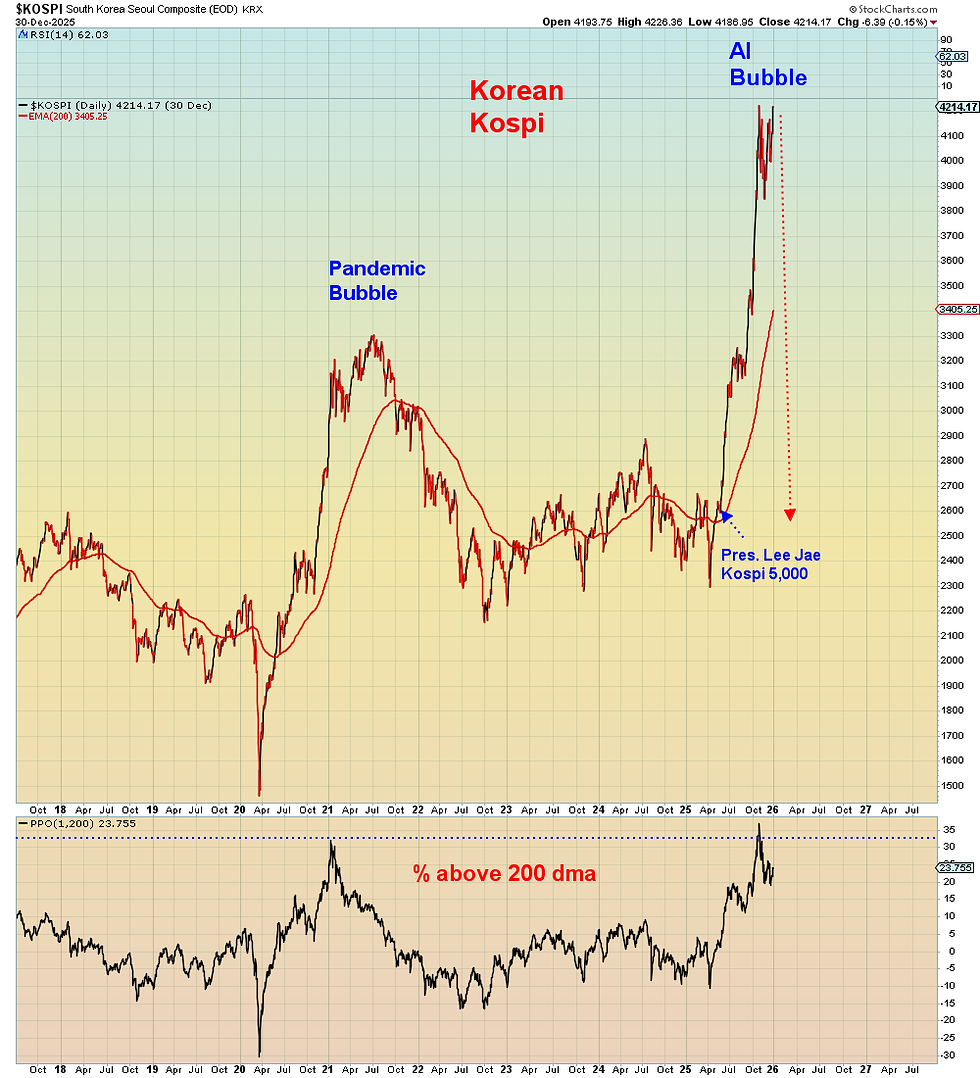
Globally, the top performing stock market was the Korean Kospi, which had its best year since 1999.
And therefore enters 2026 the most overbought since early Y2K when it spectacularly exploded.
But, just to be clear, this is NOT Y2K.
In summary, I assert that 2025 was a bull trap.
However, since the truth was utterly destroyed this year, in the new Golden Age it's everyone for themselves.
HAPPY NEW YEAR!!!


